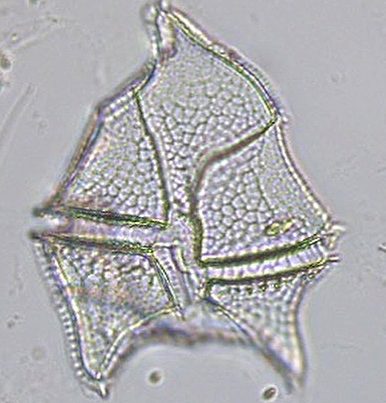
In order to begin this post, one must be familiar with the terminology of “cf.” So that is where we will begin. The “cf.” designation is very abundant in the realm of biology, especially in the world of phycology where the organisms are measured in microns. In biology the “cf.” is usually placed in-between the Genus name and the species name; but in some circumstances it will appear before the Genus name. In latin, “cf.” translates to “confer”, which means “compare to”. The “cf.” is used to describe a specimen that is difficult to identify because of practical difficulties, such as the specimen being poorly preserved, falling over/under the size range in described literature, or even be in-between stages of dividing that account for different morphological looks. In this example, “Melosira cf varians” implies that the specimen is believed to be Melosira varians but the actual identification cannot be certain, due to potential limitations.
When looking at this diatom, you might be inclined to think that its morphological category, or shape, is different that a centric; however you would be wrong. What makes a centric characteristic is:
- Valves with radial symmetry (symmetric about a point)
- Cells lack a raphe system and lack significant motility
- Cells may possess fultoportulae (strutted processes) and rimoportulae (labiate processes)
- Sexual reproduction is oogamous
AlgaeBase, provides an in-depth description of Melosira, the genus. Just to give an insight of why the “cf.” is used so frequently in literature, Algaebase currently has 370 species names of Melosira in the current database! Each with slightly different size ranges, and tiny microscopic details that set it apart just enough to call it a separate species name than another. On the plus side, only 56 have been termed as accepted taxonomically, the rest have been moved and re-called into different species and sometimes even called different Genus names.
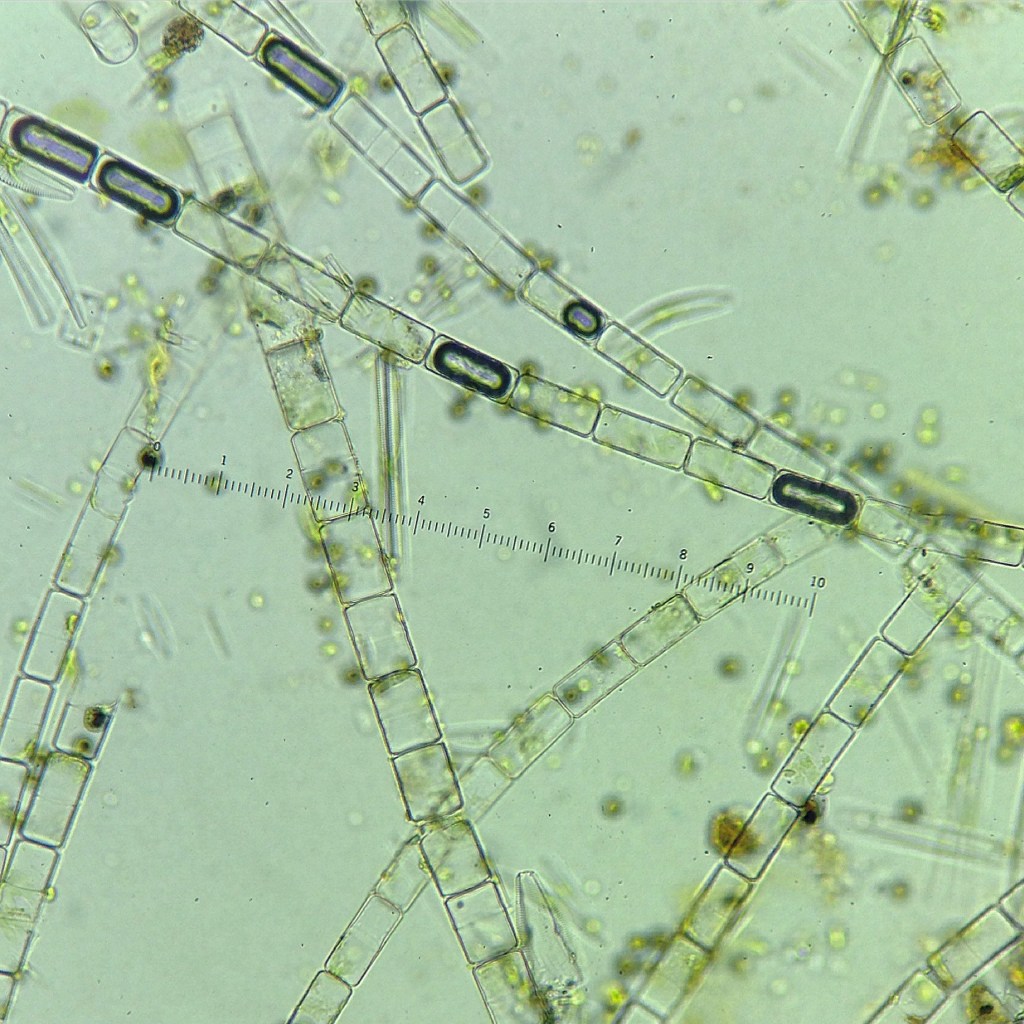
According to Diatoms.org you can see that in valve face, Melosira is in fact, a centric diatom. The characteristics that help to identify this diatom are: Cells are cylindrical, forming chains (seen clearly in below picture). Frustules are 6-30 µm in diameter with a mantle height of 5-15 µm (only certain literature size ranges, some literature reviews will have different size ranges). The valve face is slightly convex, with little to no ornamentation. Numerous rimoportulae are scattered over valve face and mantle and one row of rimoportulae occurs on the mantle edge (only seen with high powered SEM).
Please feel to explore and learn more!!! There are a ton of awesome pictures out there to show the high variability of morphological looks. A simple google search of Melosira varians, will reveal some awesome pictures. The Natural History Museum of Wales , has a very basic condensed description.
In the picture below, you can see how Melosira forms this long chains. This is an excellent example to present how a monoculture of a specific organism can reveal how competing for nutrients will provide different variability of sizes. This sample was dominated by Melosira cf. varians, and the picture shows why I used the “cf.” The size range of specific cells are different, some cells are in the middle of dividing, and some cells are broken off.
 Science Thursday