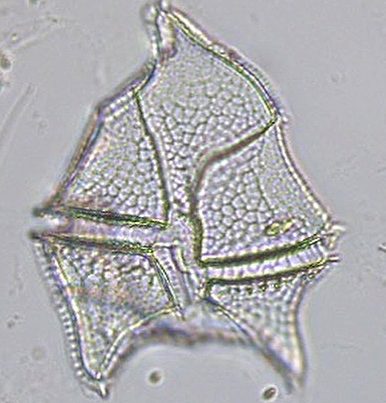
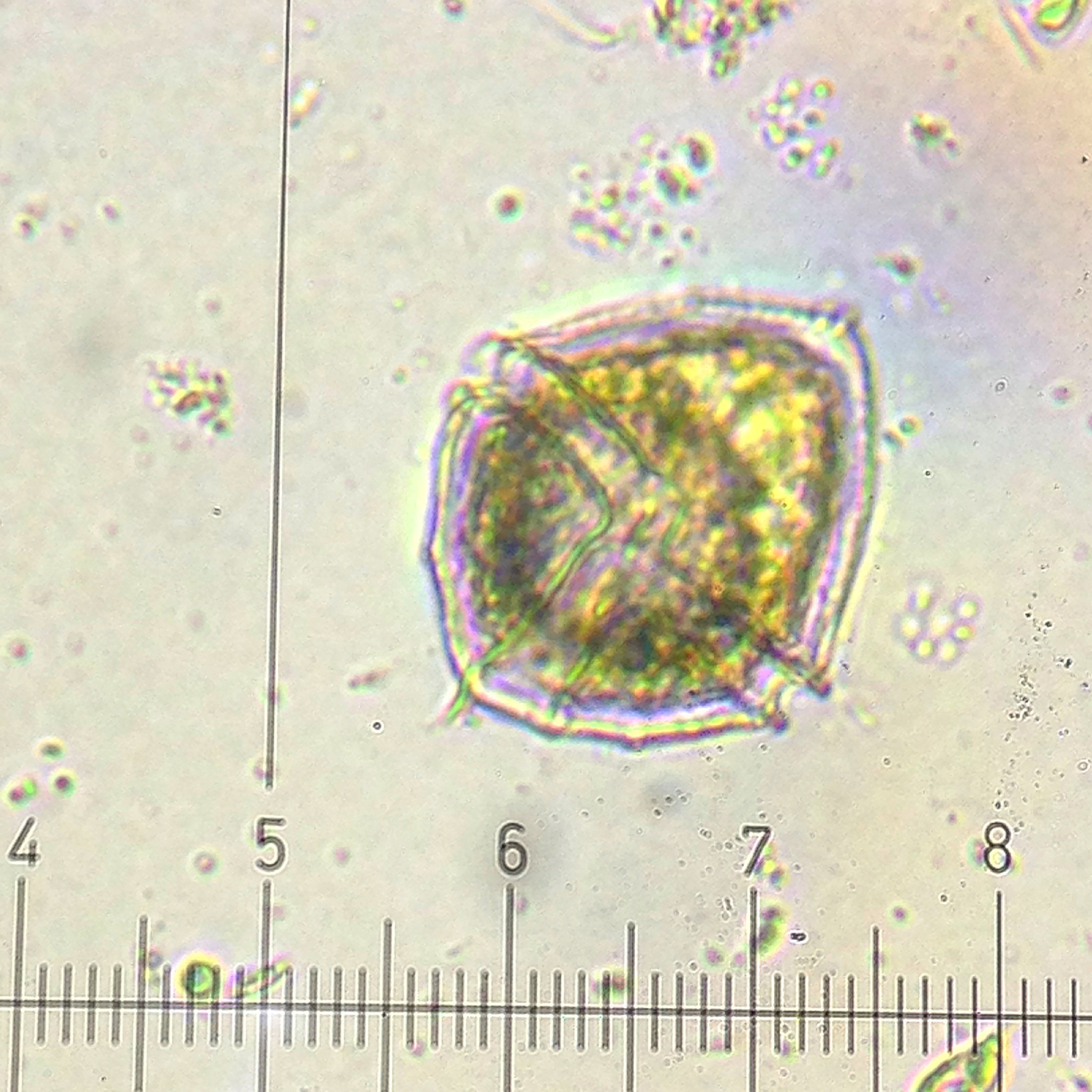
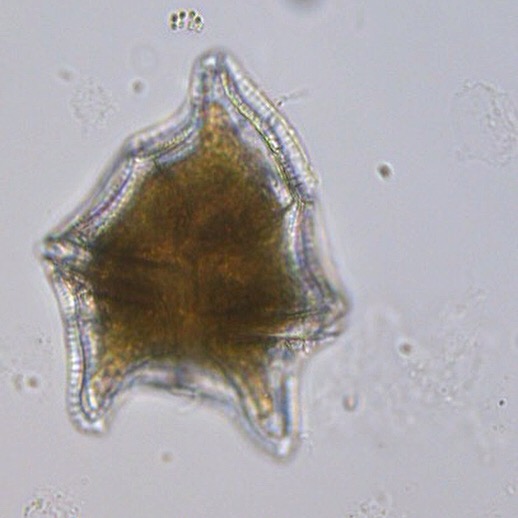
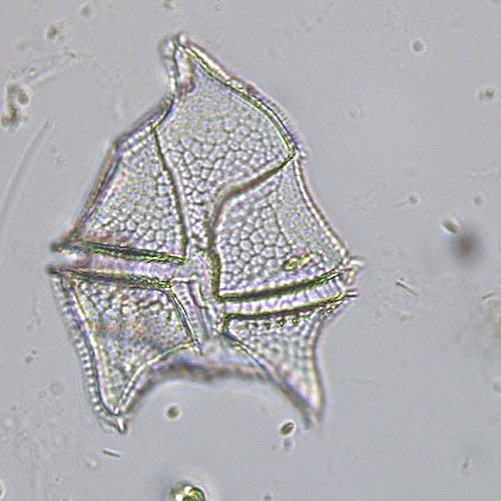
Today we will be talking about Peridinium sp. There are many different species, however when working for clients, I rarely end up putting a species name on them due to their variations in thecal plates, and how they are orientated in the water column.
The genus Peridinium (Ehrenberg, 1832) is described as “Vegetative cells, free-swimming, generally ovoid or rounded in ventral view, sometimes circular to bean shaped in apical view.” In that one sentence of a description, you can see why it is so difficult to speciate; four different options for how its supposed to look, based on how it is oriented, ventral vs. apical view. The Freshwater Algal Flora of the British Isles: An Identification Guide to Freshwater and Terrestrial Algae, purchase from Amazon here, continues to describe Peridinium as: “Epitheca and hypotheca fairly even in size, separated by well-defined cingulum with little to no offset; plate formula: (Po,x), 4′, 2-3a, 7″, 5c, 5s, 5″, 2″”).
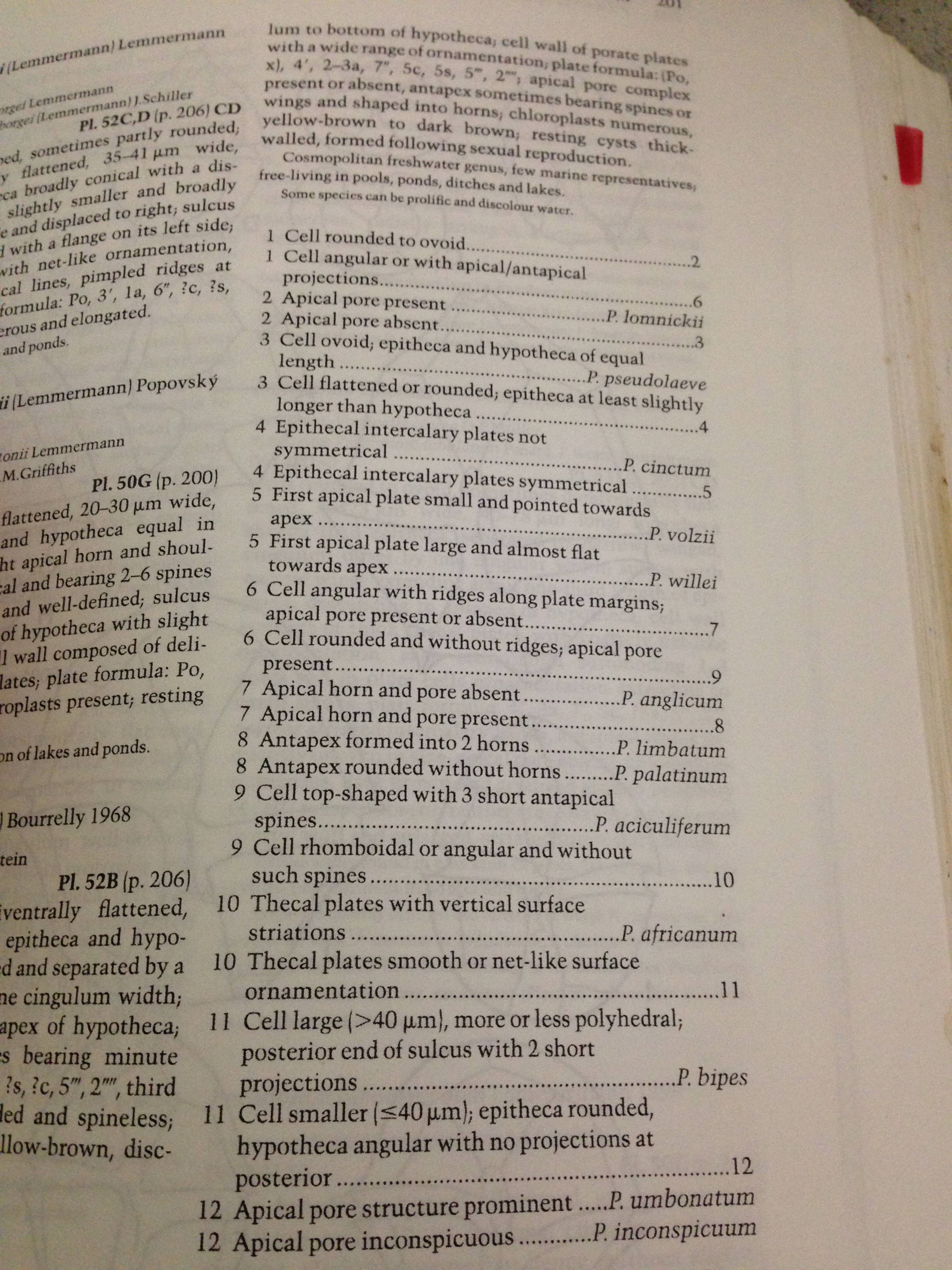
Now, as you can see from the dichotomous key above, this is how to key out different species of Peridinium based upon well-defined features that the organism exhibits. As you can see, the very first separation is based on cell shape, rounded to ovoid vs. the cell being angular. As we continue on, the major separations become; apical pore present vs. absent, epithecal intercalary plates symmetrical or not, present of apical horn, and how many horns present, and finally thecal plate structure.

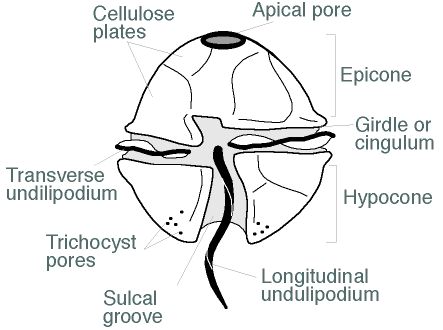
Above, is a little handout on thecal plate structure arrangements. As you can clearly see, the thecal plate arrangements are drastically different depending on how the organism is oriented, ventral vs. dorsal. This is why I mentioned I rarely end up attaching a species name to Peridinium. Here is a little diagram of the relative simple structure of a Peridinium. Protist Images, have some excellent depictions of some different species!
 Science Thursday