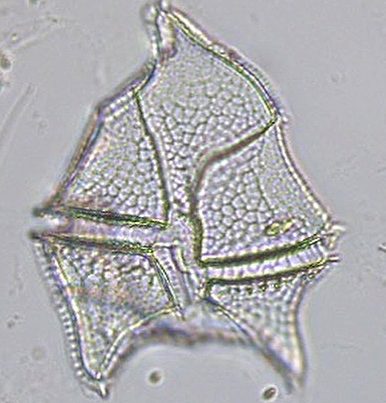
Hello folks!! Today we will be talking about Eunotia sp. I must warn you though, this is one genus of diatoms that I encounter very infrequently. However, the below picture, is one of the better quality photos I captured.
So, lets get right into it! You all must be familiar with Diatoms.org website by now, but it is a staple in my line of work. Currently, Diatoms.org has listed 53 different species for the Genus Eunotia, that have pictures, and another 86 that don’t. Now compare those numbers with how many are currently accepted by Algaebase: “There are 965 species names in the database at present, as well as 812 infraspecific names.” Quite a drastic change in numbers wouldn’t you say! Looking at the pictures provided by Diatoms.org, the majority of them are drastically different from each other, which gives a good indication on how to separate them out. However, some of them look eerily similar, giving a harder time to tease apart the slight discrepancies. For example, take a look at Eunotia perpusilla and compare that with, lets say, Eunotia enischna. You can clearly see how those two look drastically different. But as you browse the large selection of Eunotia species, you can see how some might be confused with others.
Now lets try and tease apart my picture and see what features it has that will give us any clues into what species it is. I apologize for not having scale bar in this picture…that will limit how far we can take this guy. In the previous posts, I have mentioned that size is a HUGE factor in determining species.
So let us first discuss what features the Eunotia genus has.
- Valves with a short raphe
- Raphe extends from valve mantle onto valve face
- Striae uniserate
- One rimoportula usually present at valve apex
One feature that it doesn’t go into too much detail is the: Helictoglossa. Which is the internal, distal termination of the raphe in the shape of a pair of lips or a rolled tongue. The helictoglossa occurs in many raphid diatoms. If present, it can be distinguished in the light microscope in valve view by optical dissection (focusing through many narrow, optical planes). It may also be visible in girdle view as a thickened lip of silica. Plural form is helictoglossae. From Greek for rolled tongue. (Diatoms.org)
So to leave on a cliff-hanger, without proper size notations; one can only make an assumption of what species this is. But feel free to take a look at Diatoms.org and try to see what it resembles the most.
And as always…Happy Science Thursday!
 Science Thursday