Today we will be covering Hafniomonas sp. First and foremost, it is beneficial to note that the previous name given to this organism was Pyramimonas sp. So, if any of the resources do not include Hafniomonas, it is probably still listed as Pyramimonas. Algaebase includes a quick sentence that explains why the transfer to the new genus. They explain that some original organisms lack scales, and therefore exclude it from being apart of Pyramimonas and in its new genus of Hafniomonas. Now, if you are curious about this, I encourage you to look this up for yourself, including SEM pictures.
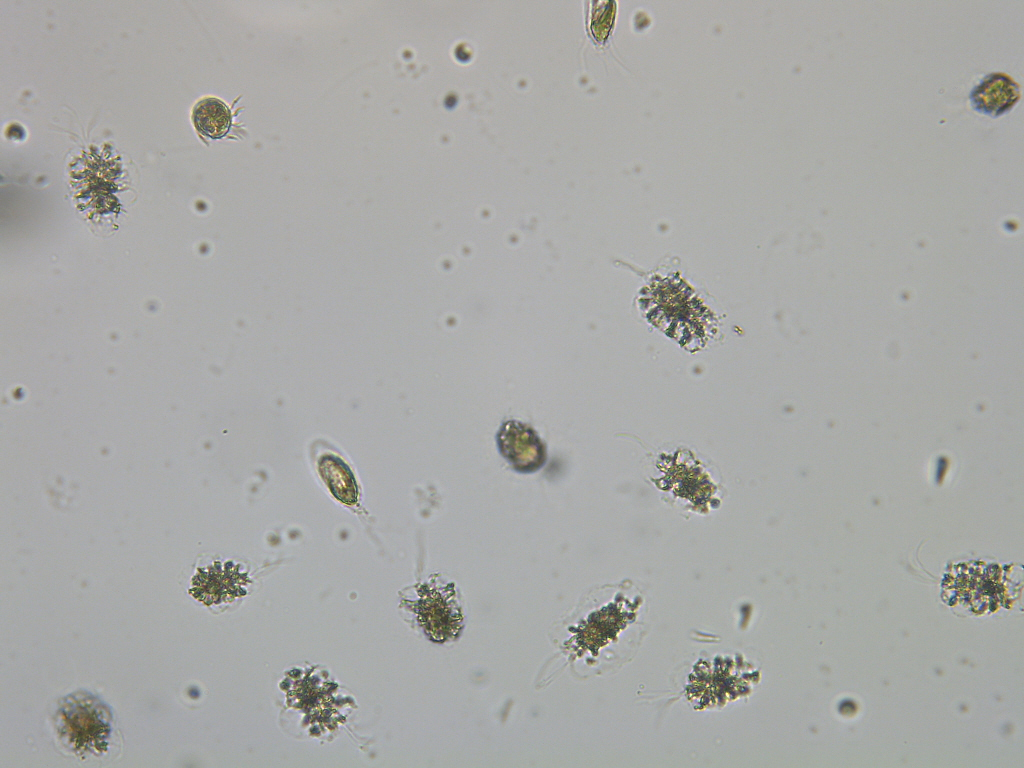
Currently, on Algaebase, there are 11 species that are accepted taxonomically, thus allowing the confidence to speciate the organism to decrease due to overlapping size-ranges and so forth. Algaebase also includes a very hefty description of the organisms characteristics. The picture below is from a real-life sample from a client, the organisms aren’t in the best shape, due to lack of sufficient preservation. However, this was the best examples I could find. You can see the 4 flagella pretty clearly, along with the overall shape and sort of odd appearance. I have chosen to identify this as Hafniomonas sp. because some of the organisms were within the size-range of the species reticulata, however, a majority of them were not. So in the best interest of the client, it was best to leave it as the genus.
The overall description for Hafniomonas sp. as regarded by “The Freshwater Algal Flora of the British Isles” is as follows: Cells in lateral view cylindrical, (6-)14-18 um wide, (8-)12-25 (-35) um long; about twice as long as wide, basally rounded but with an anterior depression from which 4 flagella arise.
Not the best specimen to observe in picture format, but it is a rare occurrence that we encounter it. Hope you enjoy!
 Science Thursday